
The Idols NFT Hack Analysis
The Idols NFT Hack Analysis
Overview:
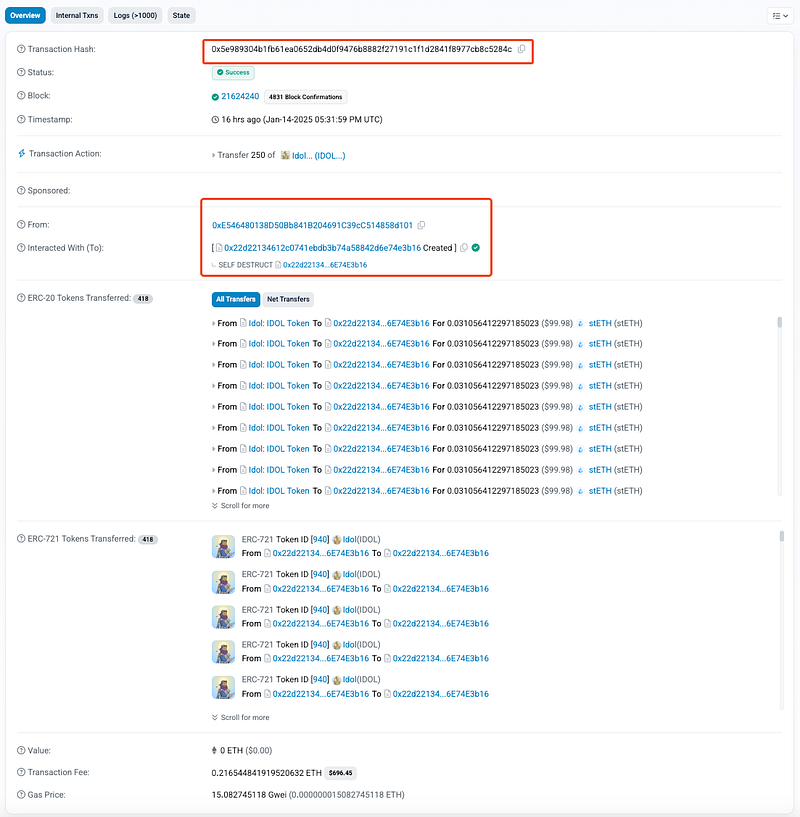
On January 15, 2025, The Idols NFT (@TheIdolsNFT) contract on Ethereum suffered an exploit resulting in a loss of approximately $340K in stETH. The vulnerability originated from flawed logic in the _beforeTokenTransfer function that failed to handle reward claiming correctly when the sender and receiver were the same address. This allowed the attacker to repeatedly claim stETH rewards through carefully crafted transactions.
Smart Contract Hack Overview:
- Attack Transactions: 0xd9870, 0x5e989, 0x2bda7, 0x45bf5, 0x14ae4, 0x1a595, 0x45d93, 0xa8289, 0xa194e, 0xa64b6, 0x1aaa3, 0x61092, 0xbffcf, 0x9ac08
- Attacker’s Address: 0xE5464
- IDOL Contract Address: 0x439ca

Decoding the Smart Contract Vulnerability:
- The root cause of the exploit was a flawed logic in the
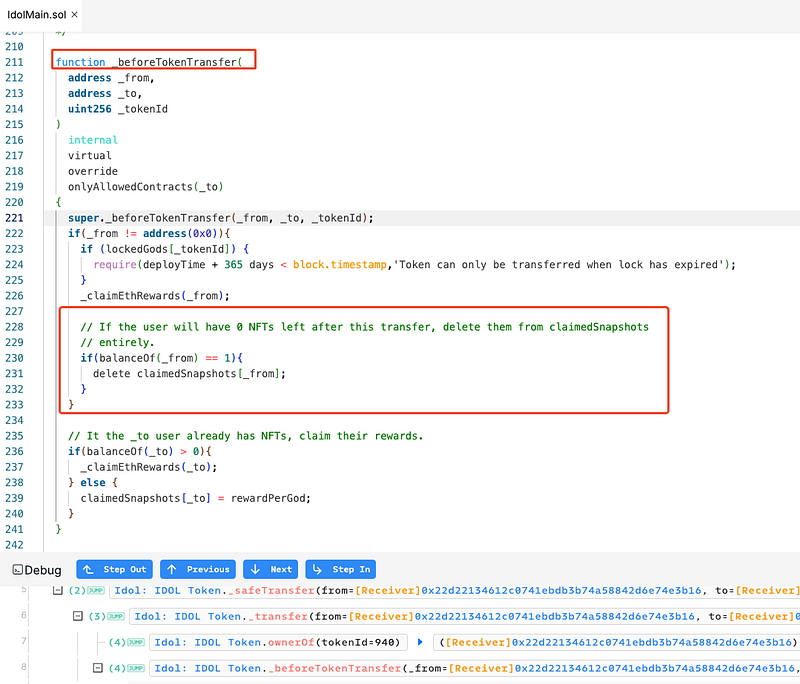
_beforeTokenTransferfunction, which mishandled the claiming of rewards during NFT (ERC721 tokens) transfers when the sender (_from) and receiver (_to) were the same address. This logic oversight allowed the attacker to repeatedly claim stETH rewards by performing self-transfers.
- When
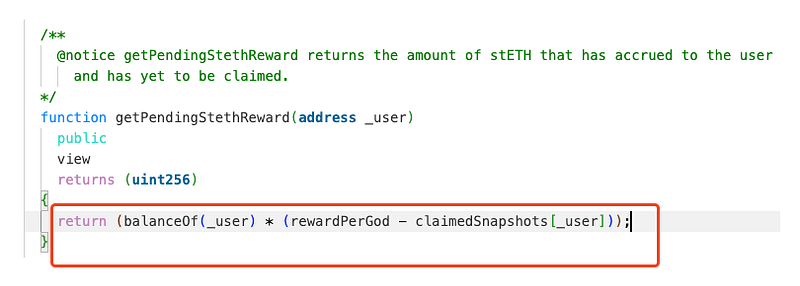
_fromand_toare the same,_beforeTokenTransferfirst calls_claimEthRewards(_from)to claim pending stETH rewards for the sender. This action calculates the sender’s rewards and transfers them based on their currentclaimedSnapshotsvalue. This uses thegetPendingStethRewardfunction, which calculates rewards as:(balanceOf(_user) * (rewardPerGod - claimedSnapshots[_user]))
- After claiming the rewards, if the sender has no NFTs (ERC721 tokens) left after the transfer (
balanceOf(_from) == 1), theirclaimedSnapshotsentry is deleted. This reset removes the record of previously claimed rewards for the sender. - Since
_fromand_toare the same,_claimEthRewards(_to)is called next. At this point,claimedSnapshots[_to]has been either deleted or reset in the previous step. The reward calculation is repeated:(balanceOf(_to) * (rewardPerGod - 0))fromgetPendingStethReward.
- The subtraction of
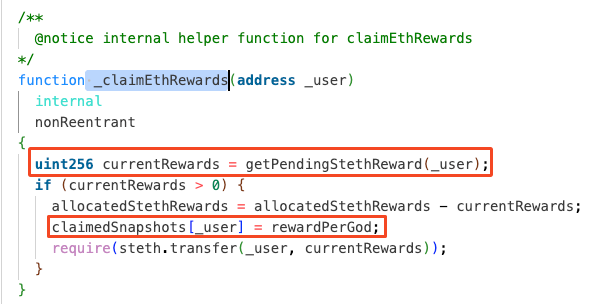
0(due to the deleted or resetclaimedSnapshots) inflates the calculated rewards, enabling the same address to claim rewards again. - Inside
_claimEthRewards, after transferring the current rewards,claimedSnapshots[_user]is reset torewardPerGod. This reset makes it appear as though the user has not claimed rewards yet, allowing further exploitation in subsequent self-transfers. The reset occurs irrespective of whether the transfer involves a new receiver or the same address. - The attacker exploited this logic by repeatedly initiating self-transfers of NFTs (ERC721 tokens). Each iteration reset
claimedSnapshots, enabling them to claim rewards anew in every transaction.
Attack Flow:
The attacker initiates an NFT transfer where
_from == _to, triggering_beforeTokenTransfer.
_claimEthRewardsis called for the sender (_from), and rewards are claimed based on the pending stETH balance.
claimedSnapshots[_from]is deleted due to theif(balanceOf(_from) == 1)check.
_claimEthRewardsis called again for the receiver (_to), which is the same address as_from.
The attacker repeats this process in multiple transactions, draining stETH rewards.
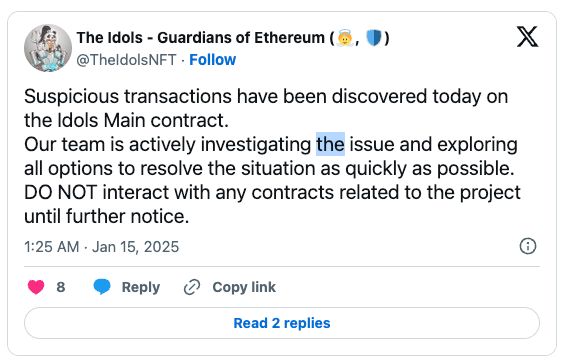
- The Idols NFT team has identified suspicious transactions on the Idols Main contract. The team is thoroughly exploring all available options to resolve the situation as quickly as possible and ensure the security of the project.
- As a precautionary measure, the team advises users to refrain from interacting with any contracts related to the Idols NFT project until further notice to avoid potential risk. Further details: https://x.com/TheIdolsNFT/status/1879256089784635690
Mitigation and Best Practices:
- Implement checks to prevent reward claims during self-transfers. If the sender and receiver are the same address, the reward claiming logic should be skipped to avoid multiple claims in a single transaction.
- Refactor the logic that resets
claimedSnapshots[_from]in the_beforeTokenTransferfunction to only delete or reset the snapshot if the NFT is actually being transferred out (i.e.,balanceOf(_from) == 1). Ensure that this reset does not occur during self-transfers, thereby preserving the integrity of the reward calculation and preventing rewards from being claimed multiple times by the same address. - Reward claims should be tied to specific actions that cause state changes, such as actual transfers of NFTs to different addresses. Ensure that rewards are only claimed when the recipient is a distinct address and not during self-transfers or no-op transactions.
- To prevent such vulnerabilities, the best Smart Contract auditors must examine the Smart Contracts for logical issues. We at CredShields provide smart contract security and end-to-end security of web applications and externally exposed networks. Our public audit reports can be found on https://github.com/Credshields/audit-reports. Schedule a call at https://credshields.com/
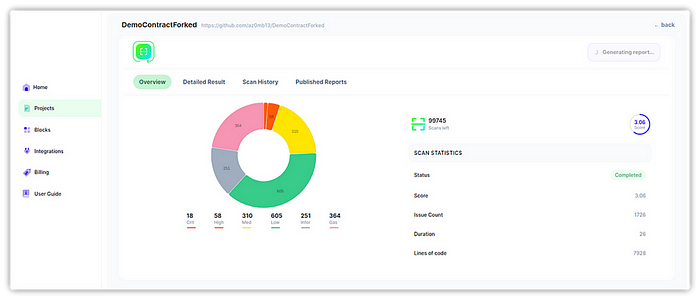
- Scan your Solidity contracts against the latest common security vulnerabilities with 280+ detections at SolidityScan.
Conclusion:
SolidityScan is an advanced smart contract scanning tool that discovers vulnerabilities and reduces risks in code. Request a security audit with us, and we will help you secure your smart contracts. Signup for a free trial at https://solidityscan.com/signup
Follow us on our Social Media for Web3 security-related updates.