
GMX v1 Hack Analysis
GMX v1 Hack Analysis

Overview:
On July 9, 2025, GMX (@GMX_IO) — a decentralized perpetuals trading protocol on Arbitrum — was exploited for over $42 million. The attacker abused a refund-based reentrancy-like vulnerability in the PositionManager.executeDecreaseOrder() function, along with an internal accounting desynchronization in the GLP pricing mechanism.
The root cause includes the implicit assumption in executeDecreaseOrder() that the _account parameter is an Externally Owned Account (EOA), when in fact it can be a malicious smart contract. This vulnerability is an combination of OWASP SC05: Reentrancy Attacks and SC03: Logic Errors.
This allowed the attacker to deploy a malicious contract and spoof GMX’s keeper execution flow to gain reentrant access into core vault logic. By hijacking control flow during ETH refunds and exploiting a stale getAum() (Assets Under Management) calculation, the attacker repeatedly minted GLP at a low price, opened phantom short positions that artificially inflated AUM, and redeemed GLP at a higher price—draining liquidity from GMX’s vault across ETH, USDC, and WBTC.
Smart Contract Hack Overview:
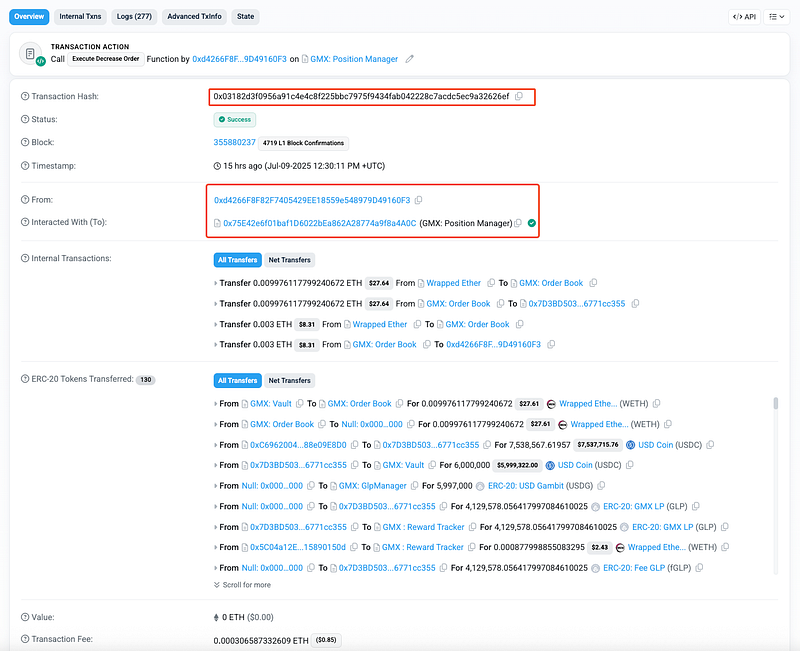
- Victim Contract: 0x489ee (vault), 0x321f6 (GLP Manager),
- Attack Transaction: 0x03182 (Arbitrum)
- Attacker Addresses: 0xDF334, 0x7D3BD
- OWAPS SC Top 10: SC05: Reentrancy Attacks and SC03: Logic Errors.
Decoding the Smart Contract Vulnerability:
- The root cause of the GMX exploit lies in the improper trust assumption in the
PositionManager.executeDecreaseOrder()function, which allowed a malicious smart contract to hijack execution flow, and in the flawed AUM (Assets Under Management) accounting logic in theGlpManager.solduring leveraged position handling. - This vulnerability led to a sophisticated multi-step attack where the attacker was able to artificially inflate the protocol’s AUM, redeem GLP for more assets than deserved, and ultimately extract over $42 million worth of tokens from the GMX vault.
- In the
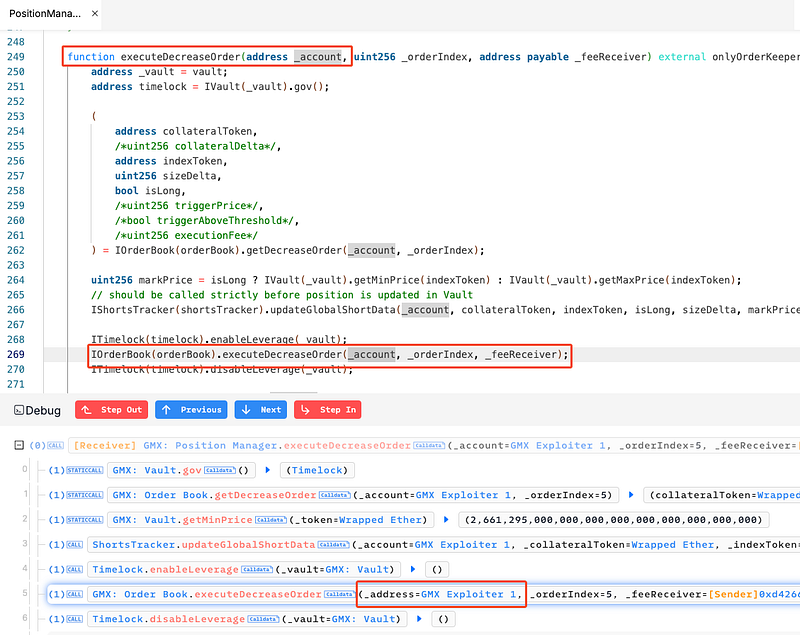
PositionManager.solcontract, the functionexecuteDecreaseOrder()is designed to be called by a privileged keeper bot, and takes the_accountas a parameter representing the user whose position is being reduced.
IOrderBook(orderBook).executeDecreaseOrder(_account, _orderIndex, _feeReceiver);
- The vulnerability arises because
_accountcan be any address, including a smart contract, yet GMX implicitly assumes it to be an EOA (Externally Owned Account). - Within the
executeDecreaseOrder(),the function internally callsgetDecreaseOrder(), which returns the full position details — including size, index token, and collateral. Then, after updating short data, the system enables leverage and calls into the order book to execute the order. During this process, the_account(attacker’s contract) is refunded ETH for gas costs using acall{value: ...}with no gas limit, which causes the fallback function of the attacker’s contract to execute. - This gives the attacker a reentrancy window to call other GMX functions while the state is in an inconsistent, pre-settlement phase — specifically, they were able to call
increasePosition()and open large short positions on WBTC whileenableLeverage = trueinside the callback of their malicious contract.
- The second key vulnerability lies in how
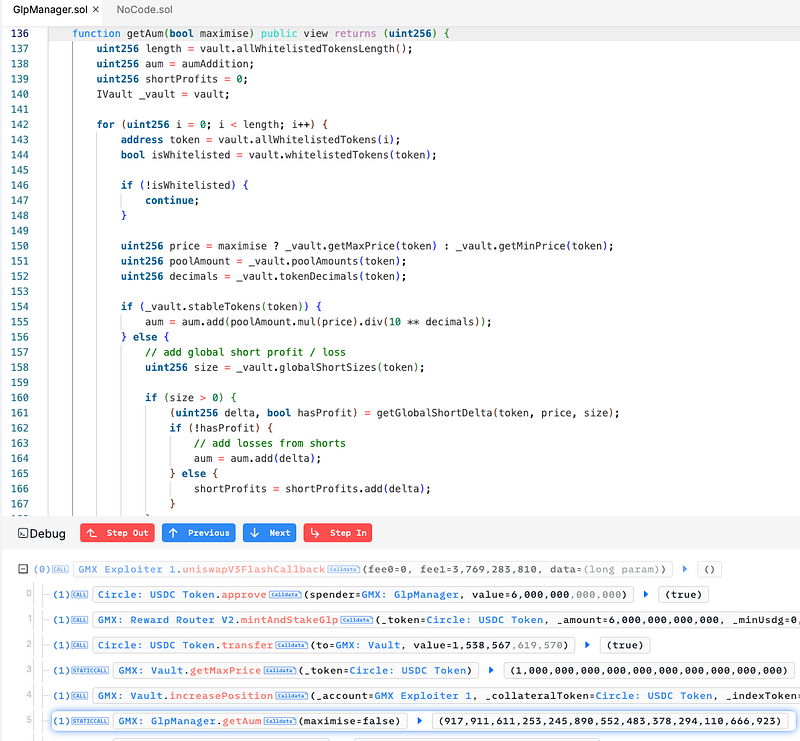
GlpManager.solcalculates the value of GLP tokens during redemption, using thegetAum()function.
function getAum(bool maximise) public view returns (uint256) {
    ...
    uint256 price = maximise ? vault.getMaxPrice(token) : vault.getMinPrice(token);
    ...
    uint256 size = _vault.globalShortSizes(token);

    if (size > 0) {
        (uint256 delta, bool hasProfit) = getGlobalShortDelta(token, price, size);
        if (!hasProfit) {
            aum = aum.add(delta); // Unrealized short losses are added to AUM
        } else {
            shortProfits = shortProfits.add(delta);
        }
    }
    ...
}
- The problem here is timing. When a short position is first opened (via reentrancy), the short size is updated immediately, but the average short price lags behind. During this in-between state, the system wrongly assumes that the position is opened at a much lower price, resulting in unrealized losses being calculated and added to AUM.
- Thus, the AUM — used in GLP redemption via
unstakeAndRedeemGlp()to determine how much value each GLP token represents — becomes artificially inflated due to mispriced unrealized losses, even though no real losses exist yet. - This allowed the attacker to redeem their GLP at an overstated value, exploiting the stale AUM calculation and draining excess assets from the vault.
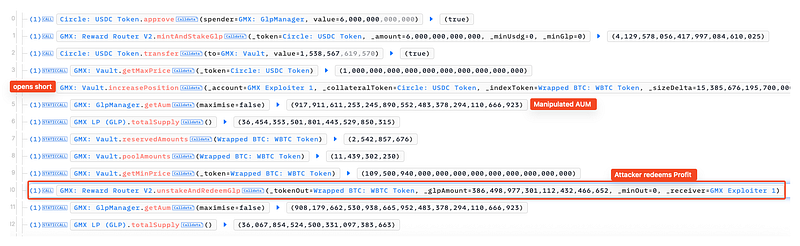
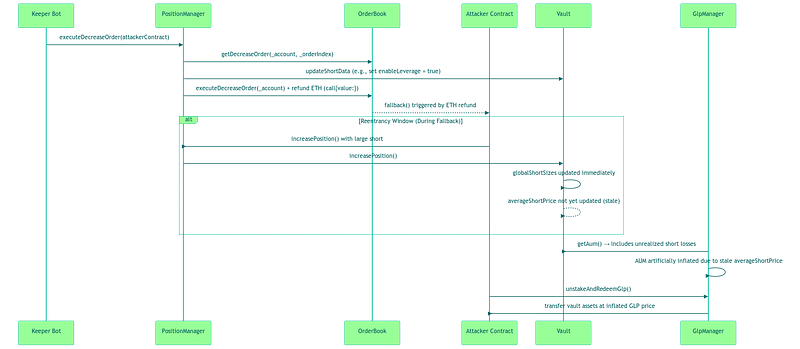
Attack Sequence:
The attacker deploys a malicious contract compatible with GMX’s
OrderBookinterface and places a crafteddecreaseOrder()using this contract.
GMX’s keeper bot calls
executeDecreaseOrder()with the attacker’s contract as_account.
As part of order execution, ETH is refunded to
_accountusingcall{value:}. This triggers the fallback function in the attacker’s contract — creating a reentrancy window
Within the callback, the attacker immediately reenters GMX logic and calls
increasePosition()to open a large short on WBTC.
The vault updates
globalShortSizesright away, butglobalShortAveragePricesstill reflects old data. This discrepancy leads the system to believe the short is deeply underwater.
When
getAum()is called, the unrealized loss from the perceived underwater short is added to AUM — artificially inflating it.
The AUM becomes artificially inflated, making GLP appear more valuable.
The attacker then calls
unstakeAndRedeemGlp()to redeem GLP tokens at the inflated AUM rate — extracting more assets than deserved.
The attacker repeats the process across various vault tokens (e.g., WBTC, ETH, USDC), draining ~$42 million from GMX’s liquidity pool.
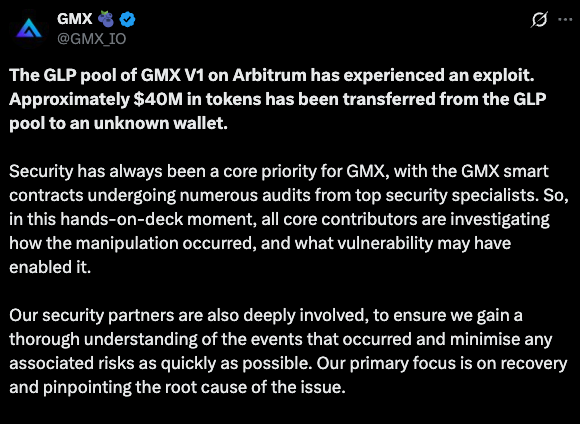
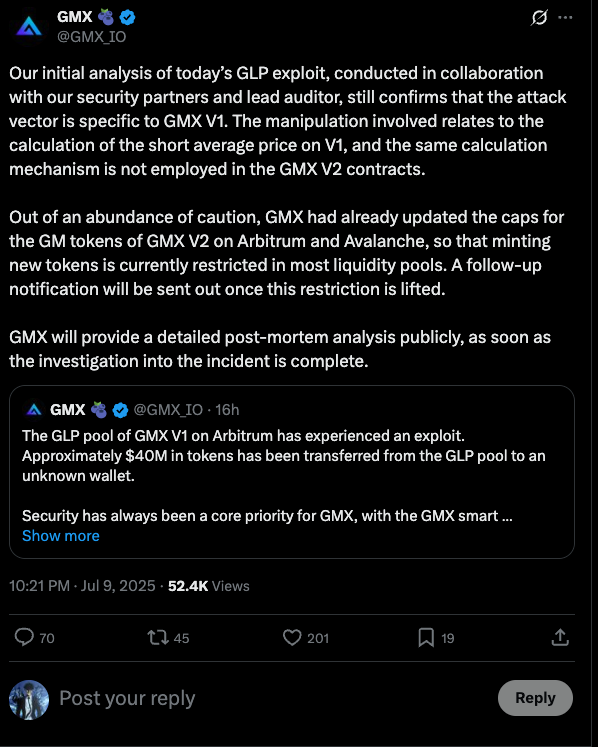
- GMX Team confirmed that the exploit is isolated to GMX V1’s GLP pool on Arbitrum. V2 contracts, GMX tokens, and liquidity pools on Avalanche remain unaffected. All GLP trading, minting, and redemption has been paused on both Arbitrum and Avalanche as a precaution. More details can be found in this X thread:
- Team member from GMX (@xdev_10) also confirmed the order keeper bot was not compromised. It executed the order flow as expected. The exploit originated from the malicious smart contract crafted by the attacker, which was used to create and hijack execution during order fulfillment.
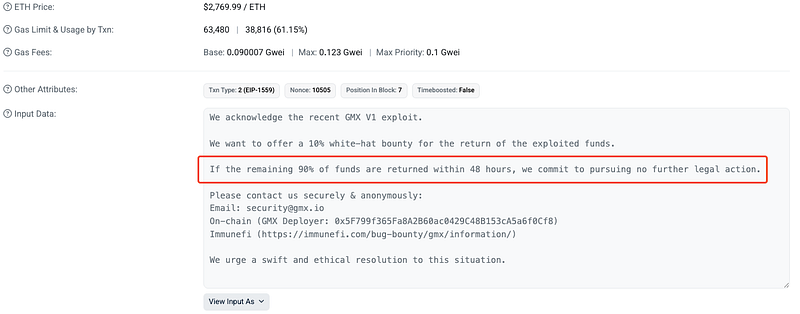
- GMX has sent an on-chain message to the exploiter, offering a 10% (nearly 4M USD) white-hat bounty for the return of funds. “If 90% of the stolen assets are returned within 48 hours, GMX commits to no legal action.” The message was embedded in this on-chain transaction.
- GMX Team is working with security partners and lead auditors to conduct a full investigation. A detailed post-mortem will be published after the review is complete. Preliminary analysis can be found here:
Mitigation and Best Practices:
- Never assume an address is an EOA. Always validate inputs like
_accountto avoid smart contract callbacks. Also avoid usingcall{value: ...}without gas limits. Prefer pull-based refund mechanisms or deferred withdrawals. - Atomically update
globalShortAveragePricesalongsideglobalShortSizesto prevent AUM miscalculations during leveraged actions.Use pull-based refunds, reentrancy guards, CEI pattern, and smooth AUM calculations to harden liquidity-sensitive logic. - Ensure off-chain bots verify all assumptions (e.g.,
_accounttype) and consider invariant testing to catch stale-state exploits early. - To prevent such vulnerabilities, the best Smart Contract auditors must examine the Smart Contracts for logical issues. We at CredShields provide smart contract security and end-to-end security of web applications and externally exposed networks. Our public audit reports can be found on https://github.com/Credshields/audit-reports. Schedule a call at https://credshields.com/
- Scan your Solidity contracts against the latest common security vulnerabilities with 494+ detections at SolidityScan.
Conclusion:
SolidityScan is an advanced smart contract scanning tool that discovers vulnerabilities and reduces risks in code. Request a security audit with us, and we will help you secure your smart contracts. Signup for a free trial at https://solidityscan.com/signup
Follow us on our Social Media for Web3 security-related updates.