
Arcadia Finance Hack Analysis
Arcadia Finance Hack Analysis

Overview:
On July 15, 2025, Arcadia Finance (@ArcadiaFi)— a liquidity and asset management protocol — was exploited for nearly $3.5 million on Base. The attacker leveraged a critical trust assumption flaw in the RebalancerSpot contract. Specifically, a swapData parameter allowed arbitrary external calls to unvalidated router addresses.
By registering their own malicious smart contract as both the router and a whitelisted ArcadiaAccount, the attacker spoofed privileged execution contexts and hijacked control flow. This allowed unauthorized withdrawals from other user accounts via manipulated rebalance flows.
The root issue lies in the assumption that the router address passed via swapData would not be a contract with elevated permissions — which was not enforced in code. Once triggered, the attacker repaid debts of a target account to meet health checks, used the Rebalancer to invoke a custom malicious call, and drained LP tokens from the victim’s position.
This vulnerability is an example of OWASP SC06:2025 Unchecked External Calls.
Smart Contract Hack Overview:
On Base:
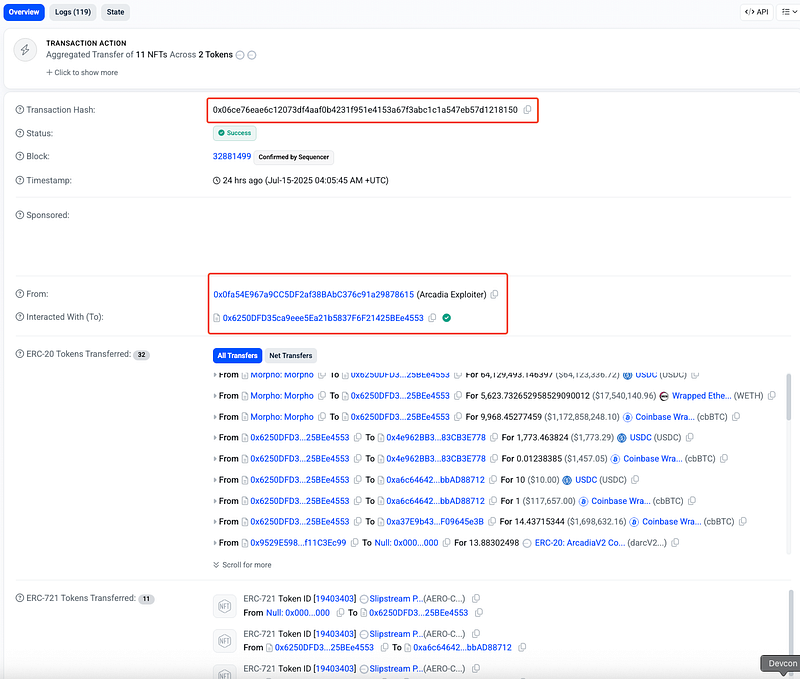
- Victim Contract: 0xC7292 (
RebalancerSpot) - Attack Transactions: 0x06ce7, 0x0b9be, 0x72398
- Attacker Addresses: 0x0fa54
- OWASP SC Top 10: SC06:2025 Unchecked External Calls
- OWASP SCWE-042: Insecure Use of External Calls
Decoding the Smart Contract Vulnerability:
- The root cause of the Arcadia Finance exploit lies in the lack of validation in the
SwapLogic._swapViaRouter()function. This allowed an attacker to inject a malicious router via therouter.call(data)mechanism, leveraging the trusted context of the Rebalancer contract (msg.sender) to perform unauthorized actions on victim accounts. - The exploit path traverses multiple contracts:
RebalancerSpot.sol,Rebalancer.sol, andSwapLogic.sol.
Rebalancer.sol- In the
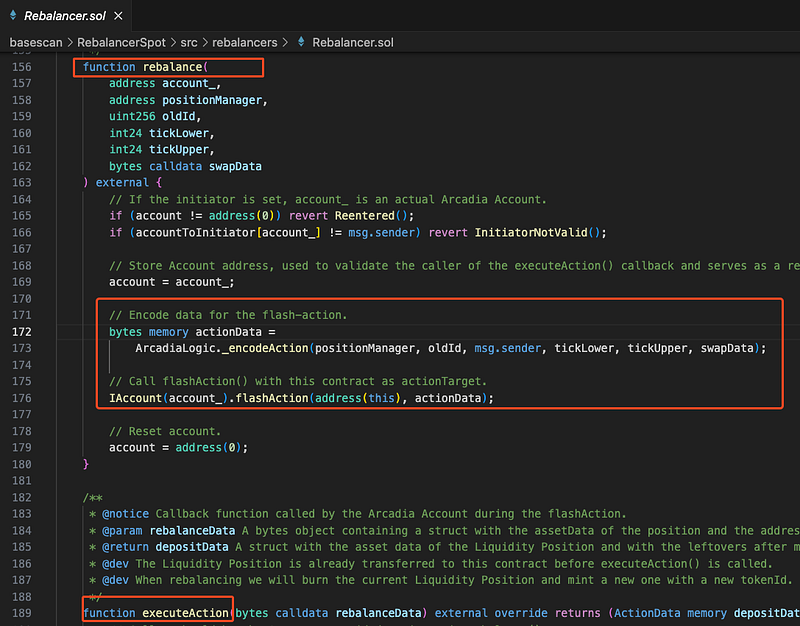
Rebalancer.solcontract, therebalance()function is externally callable and enables anyone to initiate a rebalance operation if they are registered as theinitiator.The attacker first registers as a valid initiator and then callsrebalance()with carefully craftedswapData. This data encodes a malicious router address and a payload (data) that performs unauthorized operations.
Rebalancer.executeAction() function- During the rebalance process, the
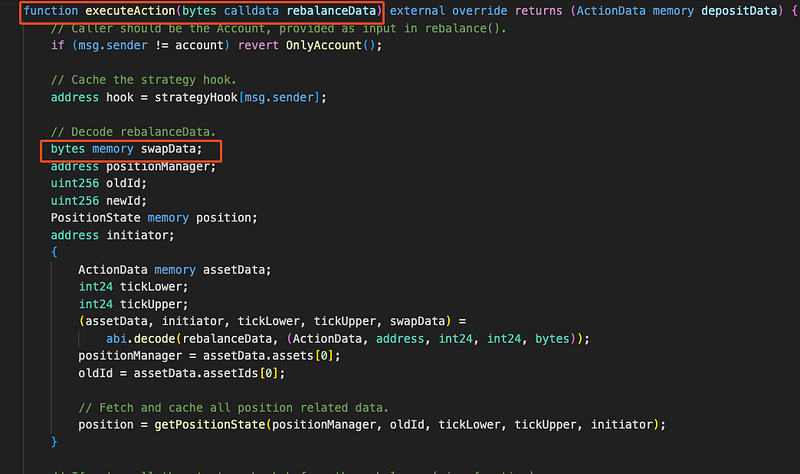
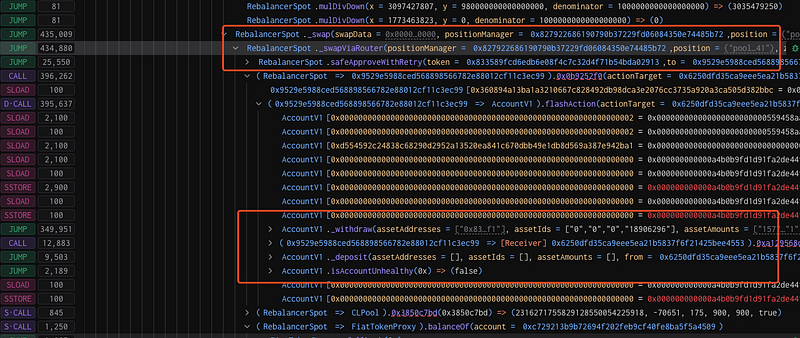
Rebalancercontract callsflashAction()on the user-supplied ArcadiaAccount, designating itself (address(this)) as the callback. This causes the ArcadiaAccount to invoke theexecuteAction()function on theRebalancer, completing the flash execution flow.
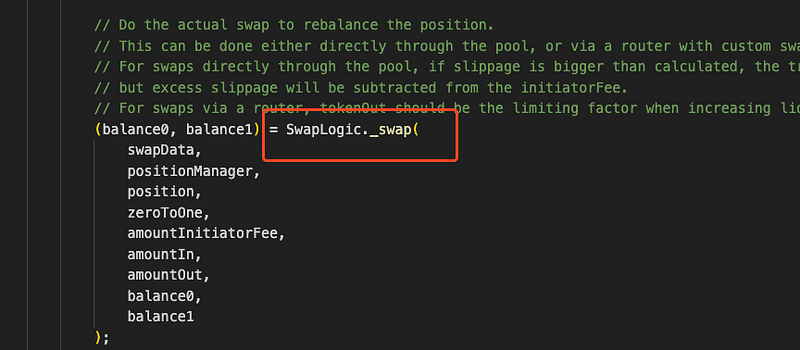
Rebalancer.executeAction()- Inside
Rebalancer.executeAction(), the swap logic is delegated toSwapLogic._swap(), which further calls_swapViaRouter(). Here lies the critical flaw. - The
_swapViaRouter()function performs two key actions:
1. Approves the exactamountInof the input token to the attacker-controlled router viasafeApproveWithRetry().
2. Executes an arbitrary low-level call to the router via:
(bool success, bytes memory result) = router.call(data);
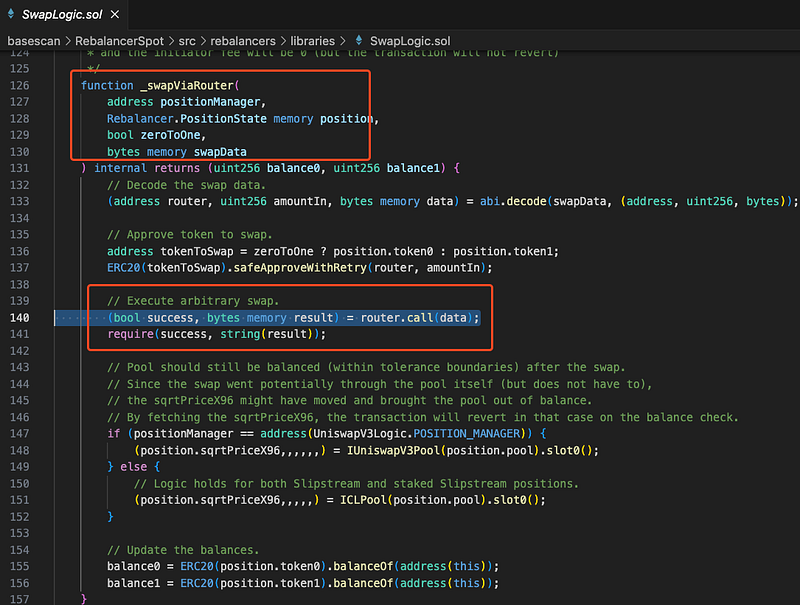
- Because this low-level call is performed from within the
Rebalancercontract, the called contract (i.e., the malicious router) seesmsg.sender == Rebalancer. - In Arcadia’s architecture,
ArcadiaAccountcontracts maintain a list of authorizedAssetManageraddresses — typically including theRebalancer. Therefore, if a contract is called from the Rebalancer’s context, it can inherit those elevated privileges. - The attacker exploited this by designing a malicious router contract that, when called, triggered sensitive functions on a different ArcadiaAccount (the victim’s). Because the Rebalancer was already whitelisted in that victim account, and because the account was in a “healthy” state (no outstanding debt), the call succeeded. The withdrawal executed as if it were from a trusted manager.
- This resulted in the unauthorized draining of liquidity provider (LP) tokens from user accounts. The Rebalancer approved the malicious contract for token transfers, and the malicious contract called sensitive functions with elevated context — effectively bypassing all access control.
- The total loss amounted to approximately $3.5 million across LP positions, all stemming from this unchecked assumption: that the
routersupplied inswapDatawould always point to a safe, external DEX (like Uniswap or 1inch). - The exploiter then swapped the stolen funds for ~840 $ ETH & bridged them from Base to Ethereum. Currently, the stolen fund is parked at:
https://basescan.org/address/0x0fa54e967a9cc5df2af38babc376c91a29878615 (~3.6M USD)
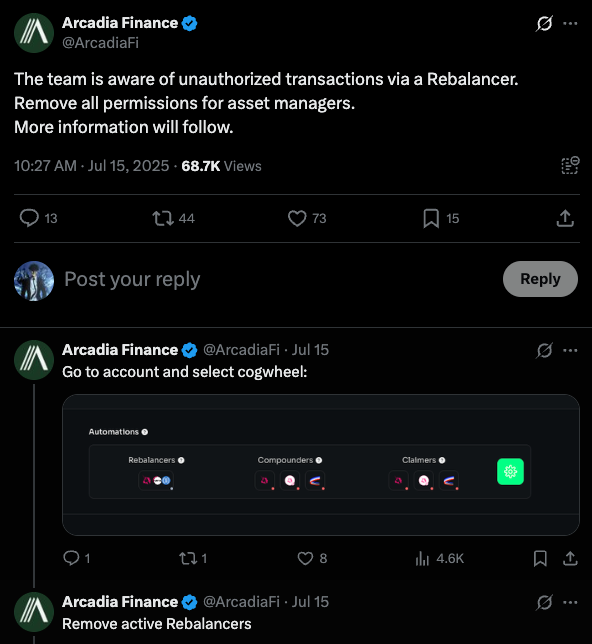
- Arcadia Team promptly acknowledged the attack and released a statement via X. More details to follow from official sources.
Read here: https://x.com/ArcadiaFi/status/1944984622183370867
Attack Sequence:
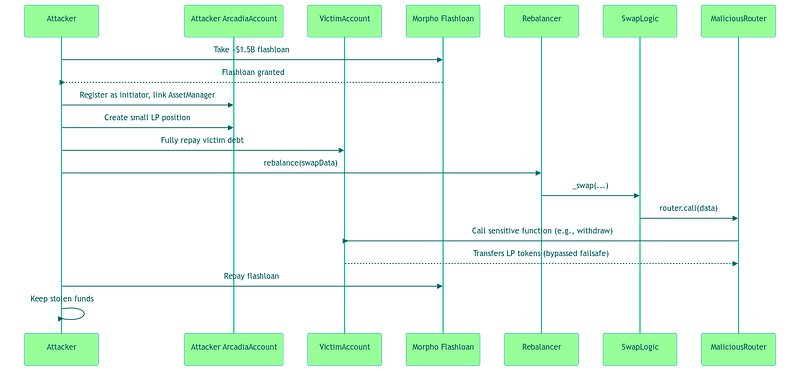
Attacker creates multiple Arcadia Accounts and takes ~$1.5B flashloan from Morpho Blue to fund the exploit.
Then, links Asset Manager to their own Arcadia Account, setting self as
initiator. And creates a small LP position to trigger the rebalance flow.
Fully repays the debt of a victim Arcadia Account using the flashloan — bringing it to a “healthy” state.
Calls
rebalance()on their own account, injecting maliciousswapData.
Inside
SwapLogic._swapViaRouter(), the attacker’s malicious contract is called viarouter.call(data).
That malicious contract executes arbitrary calls to the victim Arcadia Account (e.g., calling sensitive functions). These calls succeed because:
1. The Rebalancer is already whitelisted in the victim account.
2. The account is healthy (no active debt), so failsafes are bypassed.
Victim’s funds are transferred out to the attacker.
And the flashloan is repaid using part of the stolen funds.
Attacker now retains the remaining stolen assets.
Detection by SolidityScan:
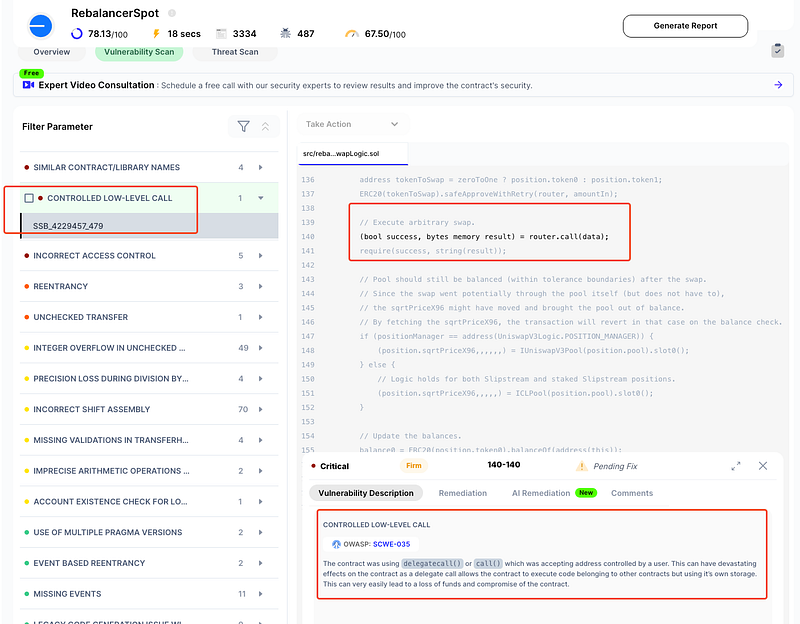
- SolidityScan was able to detect the exact vulnerable line in Arcadia Finance’s RebalancerSpot (Base) contract that led to a $3.5M exploit .
- Scanning the contract early on with SolidityScan would have flagged this critical vulnerability. This single scan could have saved Arcadia Finance over $3.5M USD and protected user funds.
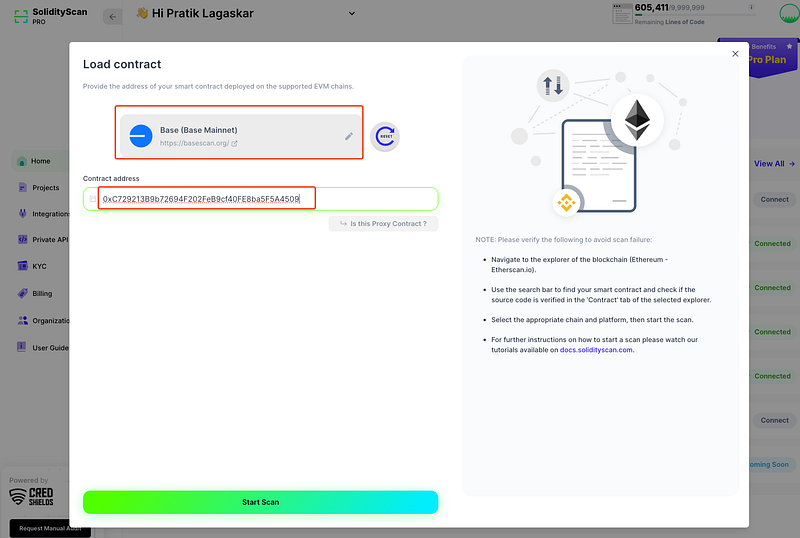
- Try it yourself at: https://solidityscan.com ! Sign up and scan the Victim Contract (RebalancerSpot) on Base (Mainnet). A detailed vulnerability report will be ready in just few moments!
- Don’t wait for a hack postmortem to learn from — catch critical bugs before they go live.
- Integrate SolidityScan into your development CI/CD pipeline and secure every deploy!
Mitigation and Best Practices:
- Ensure that only trusted DEX contracts (e.g., Uniswap, 1inch) can be passed as routers in
swapData. Maintain an allowlist of approved router addresses. - Also, do not rely solely on
msg.senderfor access control in contexts involving delegate calls or external router calls. Add explicit checks on the origin of privileged actions. - Before executing arbitrary low-level
call()s (like in_swapViaRouter()), verify that the target contract cannot execute unintended privileged logic. - Before performing privileged actions like withdrawals, verify that the action is appropriate for the account’s state (e.g., debt must be active, initiator must be whitelisted, etc.).
- Carefully audit any flow that uses flashloans or allows callbacks — especially if it allows arbitrary calldata injection — since these can introduce hidden reentrancy and privilege escalation vectors.
- To prevent such vulnerabilities, the best Smart Contract auditors must examine the Smart Contracts for logical issues. We at CredShields provide smart contract security and end-to-end security of web applications and externally exposed networks. Our public audit reports can be found on https://github.com/Credshields/audit-reports. Schedule a call at https://credshields.com/
- Scan your Solidity contracts against the latest common security vulnerabilities with 494+ detections at SolidityScan.
Conclusion:
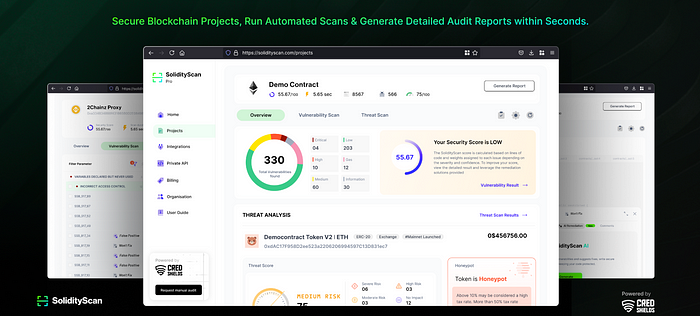
SolidityScan is an advanced smart contract scanning tool that discovers vulnerabilities and reduces risks in code. Request a security audit with us, and we will help you secure your smart contracts. Signup for a free trial at https://solidityscan.com/signup
Follow us on our Social Media for Web3 security-related updates.